Solar Panel Wire Size: The Small Detail That Can Make a Big Difference in Your Solar System
20th Nov 2026
When people plan a new solar installation, most of the attention goes to the panels. How many watts do they produce? Will they fit on the RV roof? Is the battery large enough? What kind of charge controller should be used?
The wiring usually comes later.
It is easy to understand why. Cables are not particularly exciting, and compared with a large solar panel or a lithium battery, they hardly seem like the most important part of the system. But anyone who has worked on an off-grid installation knows that the details between the components matter just as much as the components themselves.
A solar panel can produce plenty of electricity, but that energy still needs to travel through cables before it reaches the battery. If those cables are poorly selected, some of the system's potential can be lost along the way.
The distance between your panels and battery matters
Consider two RV owners installing identical solar panels.
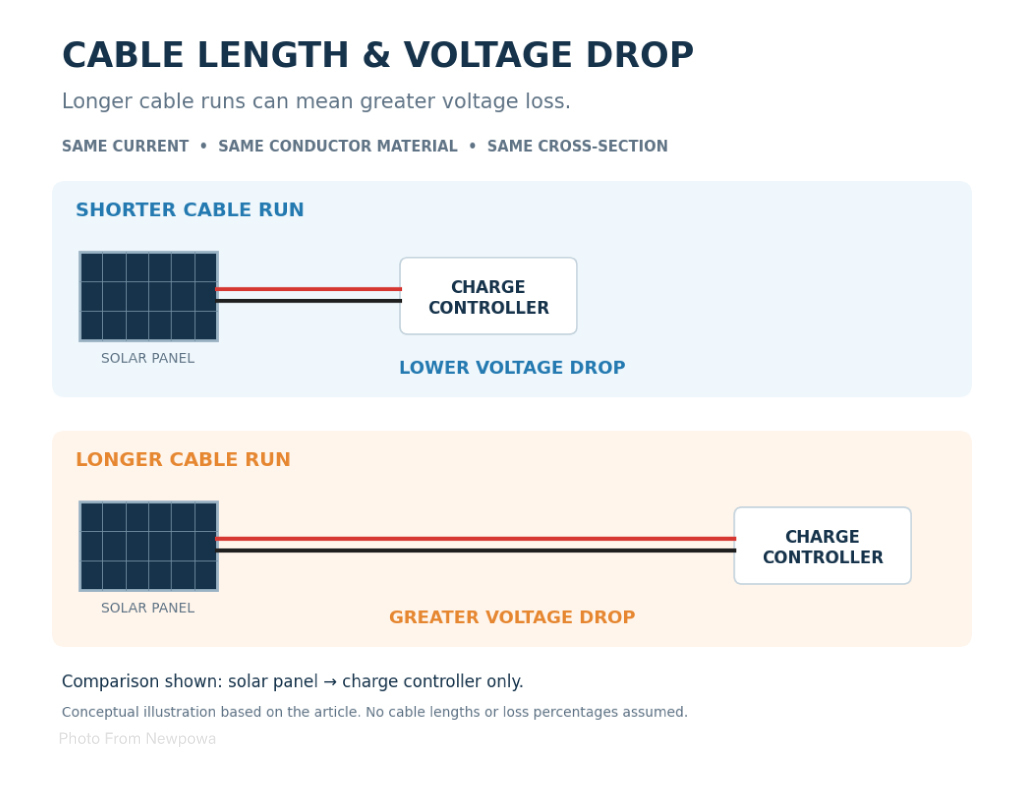
One places the charge controller directly beneath the roof-mounted panels. The other installs the controller several metres away, closer to the battery compartment.
Although both systems use the same panels, their wiring requirements may be different.
Every electrical cable has some resistance. As electricity travels through it, a small amount of voltage is lost. The longer the cable, the more noticeable this loss can become. The amount also depends on the wire's thickness and the current flowing through it.
This is known as voltage drop, and it is one of the reasons cable length should be considered before an installation begins.
Bigger is not always better, but undersized wiring is a problem
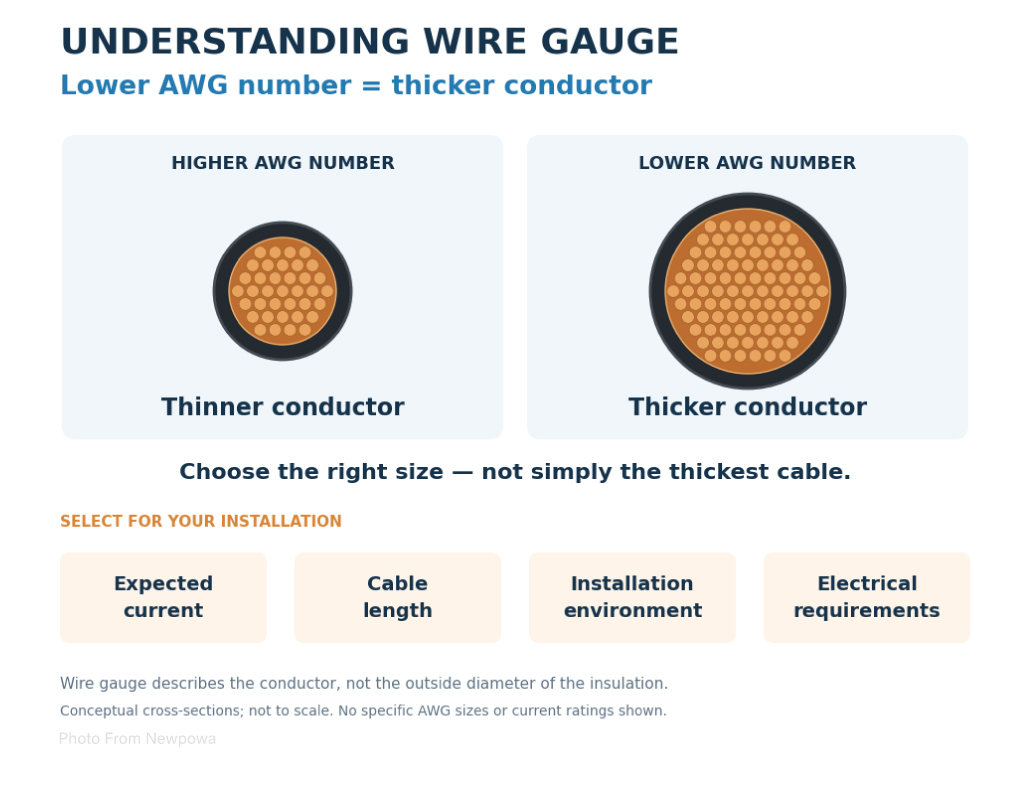
Solar cable is commonly discussed in terms of wire gauge. In general, a lower AWG number indicates a thicker conductor.
A thicker cable can carry more current with less resistance, but it also takes up more space and may be more difficult to route through a compact installation.
The objective is not simply to purchase the thickest cable available. It is to select a conductor appropriate for the expected current, cable length, installation environment, and applicable electrical requirements.
This becomes particularly important in low-voltage systems. A given amount of electrical power requires more current at a lower voltage, which can make cable selection more demanding.
An RV installation is different from a stationary solar setup
A solar system installed on a cabin may remain in place for years. An RV, boat, or mobile installation faces a different set of conditions.
Cables may be exposed to vibration, temperature changes, moisture, and repeated movement. Connections also need to remain secure while the vehicle is travelling.
For this reason, cable insulation, temperature ratings, environmental protection, and connector compatibility deserve attention alongside wire gauge.
The same principle applies to fuses and circuit protection. A properly designed solar installation needs protection suited to the conductor and equipment, not simply cables that appear large enough.
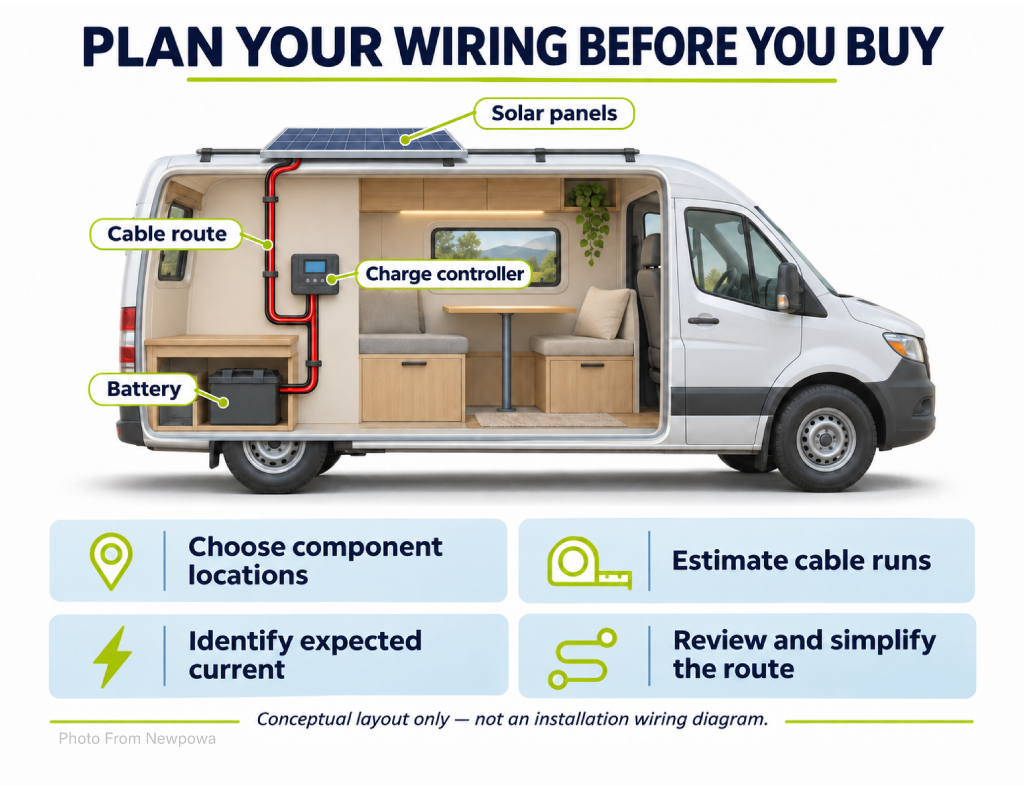
Plan the wiring before buying the equipment
One of the easiest ways to avoid unnecessary complications is to sketch out the system before purchasing its components.
Decide where the panels will be installed, where the charge controller will sit, and how the cables will reach the battery. Estimate the cable runs and identify the expected electrical current.
This also gives you an opportunity to reconsider the layout. Sometimes moving a charge controller or changing the cable route can simplify the installation considerably.
Solar systems are often judged by their panel wattage and battery capacity, but reliable performance depends on how well everything works together.
The cables may not be the most visible part of an installation. They are, however, the connections that allow the entire system to do its job.