Rigid vs. Flexible Solar Panels for Overlanding & RV Upfits: Selecting the Right Substrate
16th Nov 2026
Selecting the right solar panels for an RV, overland build, camper van, or marine vessel is one of the most critical decisions in off-grid power design. While electrical specifications like wattage and open-circuit voltage are vital, the physical substrate of the panel—whether rigid tempered-glass or lightweight semi-flexible ETFE—determines how your system handles vibration, aerodynamics, heat dissipation, and long-term environmental exposure.
For DIY builders, commercial RV upfitters, and fleet operators, understanding the engineering trade-offs between rigid and flexible substrates ensures your off-grid system yields maximum energy for years to come.
Key Takeaways
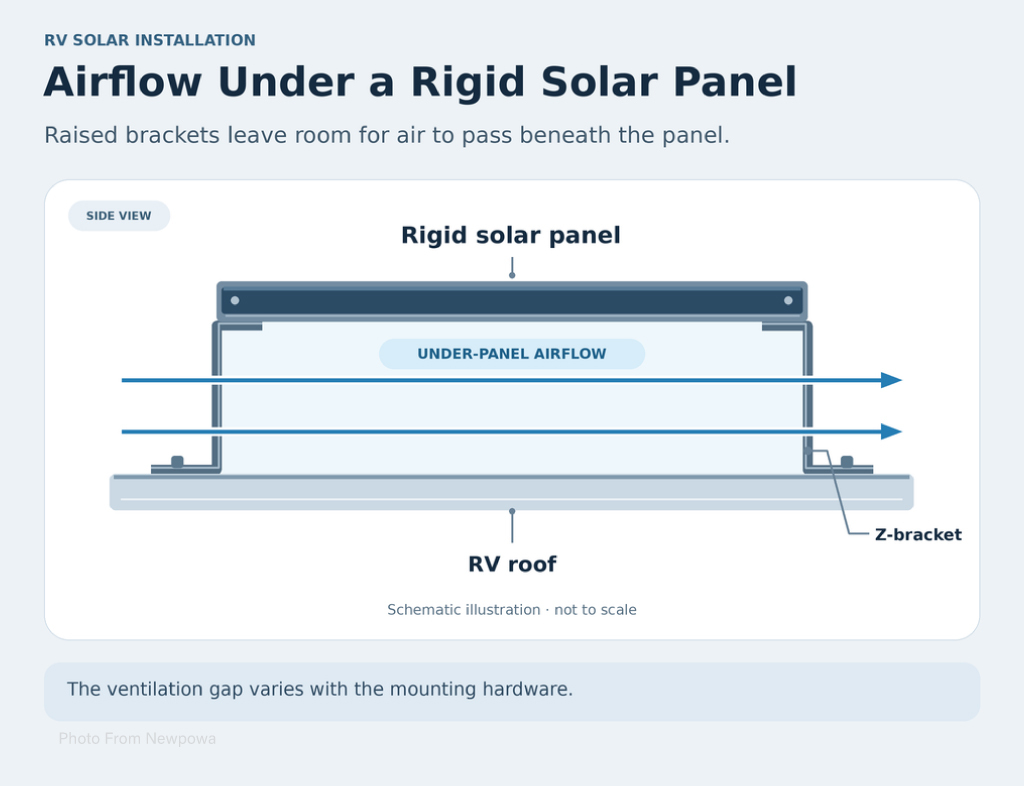
Thermal Efficiency Advantage: Rigid solar panels feature an air gap underneath the frame that dissipates heat. Flexible panels mounted flush to a roof trap heat, which reduces cell efficiency during high-temperature summer days.
Aerodynamics & Weight: Semi-flexible panels weigh roughly 70% less than rigid panels and sit almost flush against curved roofs, making them ideal for weight-sensitive or low-clearance builds.
Longevity & Durability: Heavy-duty rigid panels with tempered glass and anodized aluminum frames offer superior resistance to impact, hail, and branch strikes on rugged overland trails.
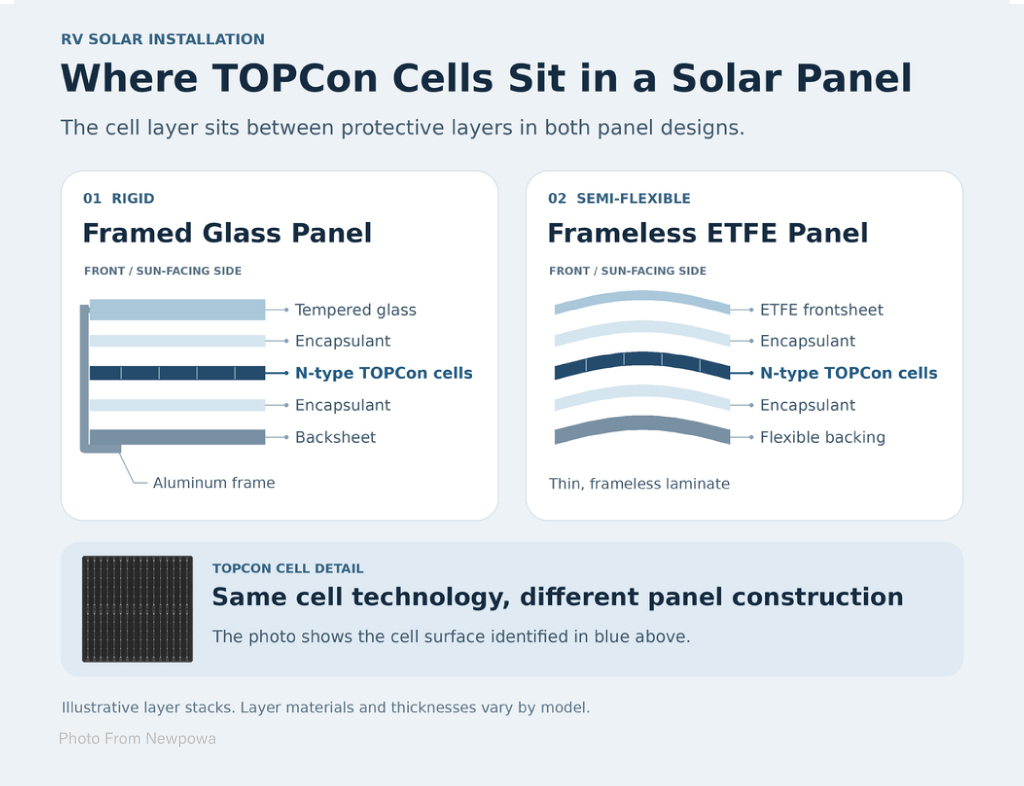
TOPCon Cell Integration: Next-generation N-Type TOPCon cells improve heat tolerance and low-light performance across both rigid and flexible product lines.
Rigid Solar Panels: The Gold Standard for Off-Grid Endurance
Rigid solar panels consist of monocrystalline silicon cells protected by heavy-duty tempered glass and enclosed in an anodized aluminum alloy frame. They are the traditional choice for stationary off-grid cabins, commercial equipment, and sturdy RV roof racks.======================== <- RV / Roof Rack Surface
Advantages of Rigid Panels
Superior Thermal Performance: Mounting a rigid panel using Z-brackets creates a 1-to-2-inch air gap between the panel backsheet and the roof. Airflow underneath cools the panel, keeping operating temperatures lower and maintaining peak power production ($P_{max}$).
Maximum Durability & Lifespan: Tempered glass and aluminum frames withstand severe weather, tree branch scrapes on tight trails, and heavy snow loads up to 5400 Pa.
Easier Upgrades & Replacement: Standardized dimensions and mounting points allow individual panels in an array to be unbolted and replaced easily if damaged.
Considerations for Rigid Panels
Higher weight profile (typically 15 to 30 lbs per panel).
Requires flat mounting surfaces or structural roof racks.
Slightly higher aerodynamic drag on high-roof vehicles.
Flexible Solar Panels: Lightweight Power for Curved Surfaces
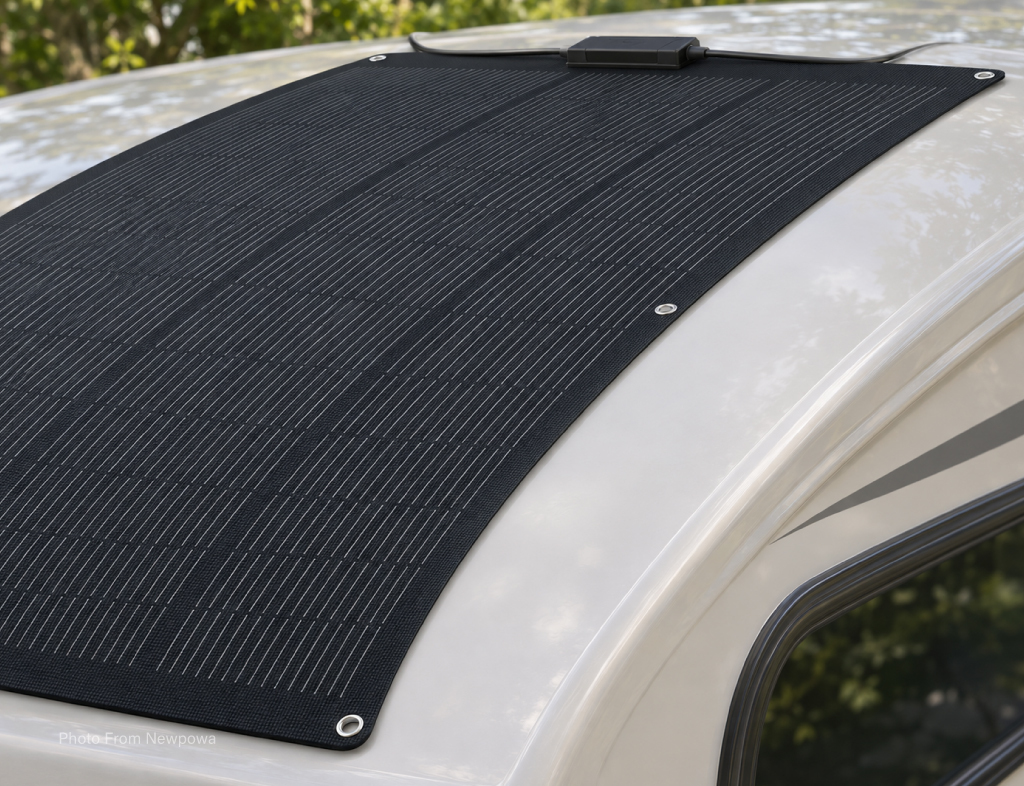
Flexible solar panels replace heavy glass and aluminum frames with lightweight, durable polymers such as ETFE (Ethylene Tetrafluoroethylene) and semi-flexible fiberglass backsheets. These panels can bend up to 30 degrees, making them purpose-built for curved pop-top roofs, teardrop trailers, and marine biminis.
Advantages of Flexible Panels
Ultra-Low Profile & Lightweight: Weighing a fraction of traditional glass panels, flexible solar units add minimal weight to van pop-tops and retain clean vehicle aerodynamics.
Conforms to Curved Surfaces: Can be mounted directly onto contoured surfaces, fiberglass shells, or curved boat decks using structural adhesives or grommets.
No Drilling Required: Many upfitters install flexible panels using high-bond mounting tapes or adhesives (like 3M VHB or Sikaflex), avoiding roof penetrations.
Considerations for Flexible Panels
Heat Accumulation: Flush-mounted flexible panels cannot dissipate heat through undersurface airflow. On hot summer days, cell temperatures rise higher, which can lead to a slight drop in daily power yield.
Surface Vulnerability: While ETFE coatings are scratch-resistant and durable, flexible substrates are more susceptible to physical impact from heavy falling debris compared to tempered glass.
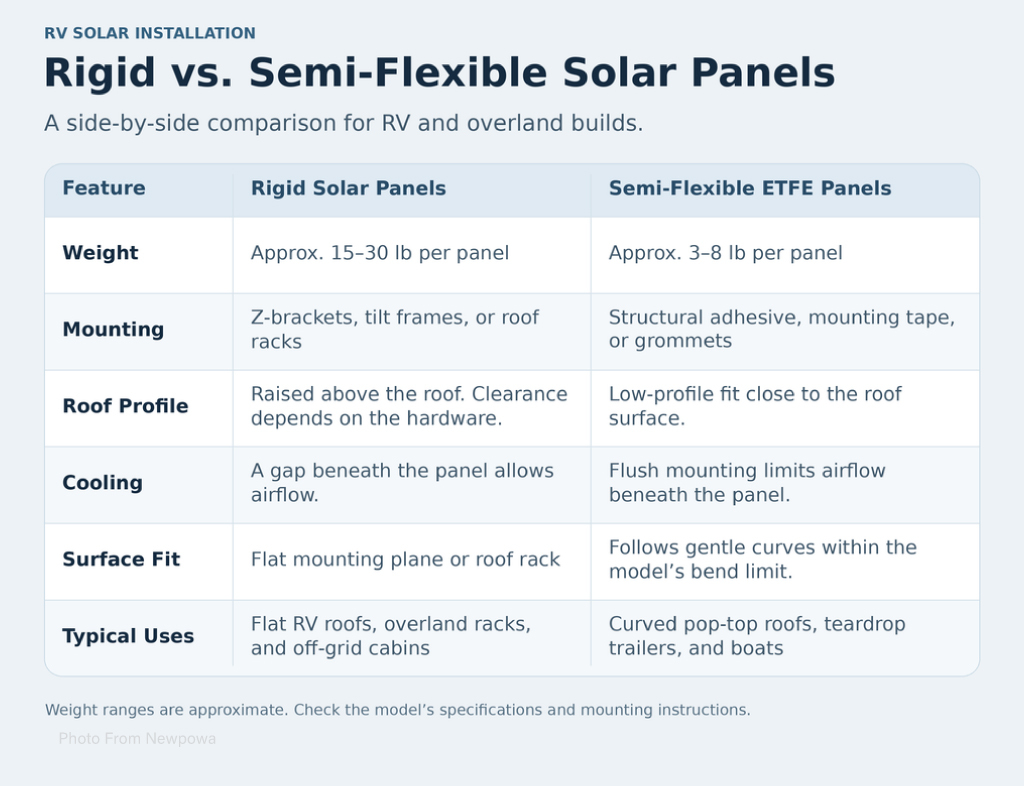
Technical Comparison Matrix
|
Feature / Specification |
Heavy-Duty Rigid Solar Panels |
Semi-Flexible ETFE Solar Panels |
|
Weight |
Standard (~15–30 lbs per panel) |
Ultra-Lightweight (~3–8 lbs per panel) |
|
Mounting Mechanism |
Z-Brackets, Tilt Frames, Roof Racks |
Structural Adhesive, VHB Tape, Grommets |
|
Roof Profile |
1.5” to 3.0” Clearance |
Ultra-low profile (< 0.1” height) |
|
Thermal Dissipation |
Excellent (Under-panel airflow gap) |
Moderate (Direct roof contact) |
|
Surface Flexibility |
Rigid / Flat Surfaces Only |
Flexible (Bends up to 30°) |
|
Ideal Applications |
Off-Grid Cabins, Flat RV Roofs, Overland Racks |
Pop-Top Vans, Teardrop Campers, Boats |
Mitigating Heat Losses with Next-Gen TOPCon Cells
Whether you choose rigid or flexible panels, cell technology plays a huge role in real-world energy production. Standard PERC cells suffer notable performance drops as temperatures rise above $25^\circ\text{C}$ ($77^\circ\text{F}$).
Newpowa's N-Type TOPCon (Tunnel Oxide Passivated Contact) cell technology solves this issue with a lower (more favorable) temperature coefficient. TOPCon cells retain a higher percentage of their rated wattage in high ambient heat, helping flexible panels overcome roof heat accumulation and allowing rigid panels to produce even higher peak yields in mid-summer.
Which Panel Substrate Is Right for Your Setup?
Choose Rigid Solar Panels if: You have a flat roof rack or rigid mounting space, prioritize maximum long-term durability and heat clearance, or plan to travel through heavy brush and rugged off-road terrain.
Choose Flexible Solar Panels if: You are mounting onto a curved pop-top, teardrop trailer, or fiberglass roof shell, need to keep overall vehicle weight low, or want a low-profile installation without drilling holes.
Both panel styles integrate seamlessly into standard 12V, 24V, or 48V off-grid systems when paired with an MPPT Charge Controller, providing reliable power wherever your adventures take you.
? Ready to build or upgrade your mobile solar array?
Explore Newpowa’s complete line of High-Efficiency Rigid TOPCon Panels, Lightweight Flexible Solar Series, and Heavy-Duty MPPT Charge Controllers at Newpowa.com!