The Future of B2B Solar Procurement: What Is a TOPCon Solar Cell and Why Wholesale Buyers Need It
26th Jul 2026
For the better part of a decade, standard PERC (Passivated Emitter and Rear Cell) technology has been the workhorse of the solar industry. It provided reliable performance at a predictable cost per watt, making it the default choice for commercial solar deployments. But as we move deeper into 2026, the ceiling for PERC efficiency has been reached.For operations managers, wholesale buyers, and B2B procurement teams, the math has fundamentally changed. The new standard for commercial installations, large-scale remote infrastructure, and industrial rooftops is TOPCon.
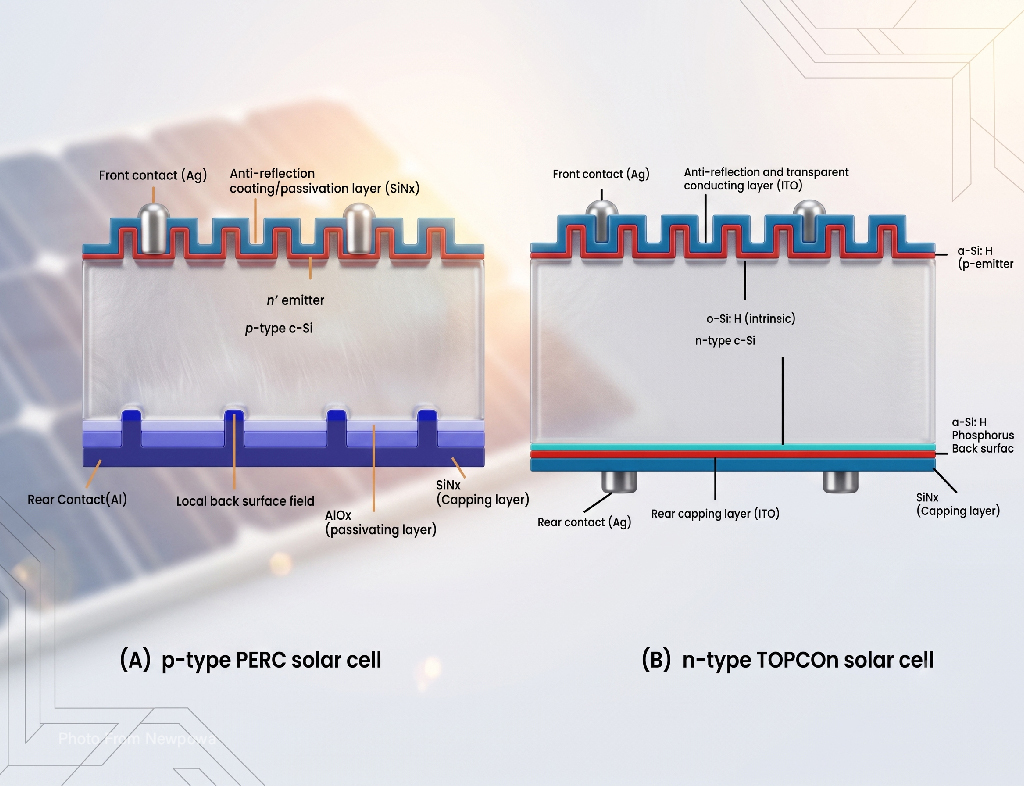
Here is a breakdown of what TOPCon technology actually is, and why future-proofing your scalable deployments requires transitioning your inventory to it today.
What Is a TOPCon Solar Cell?
TOPCon stands for Tunnel Oxide Passivated Contact.To understand why it matters, you have to look at how solar cells lose power. In traditional P-type PERC cells, electrons generated by sunlight can easily recombine with the silicon before reaching the circuit, which means that energy is lost as heat instead of being captured as electricity.
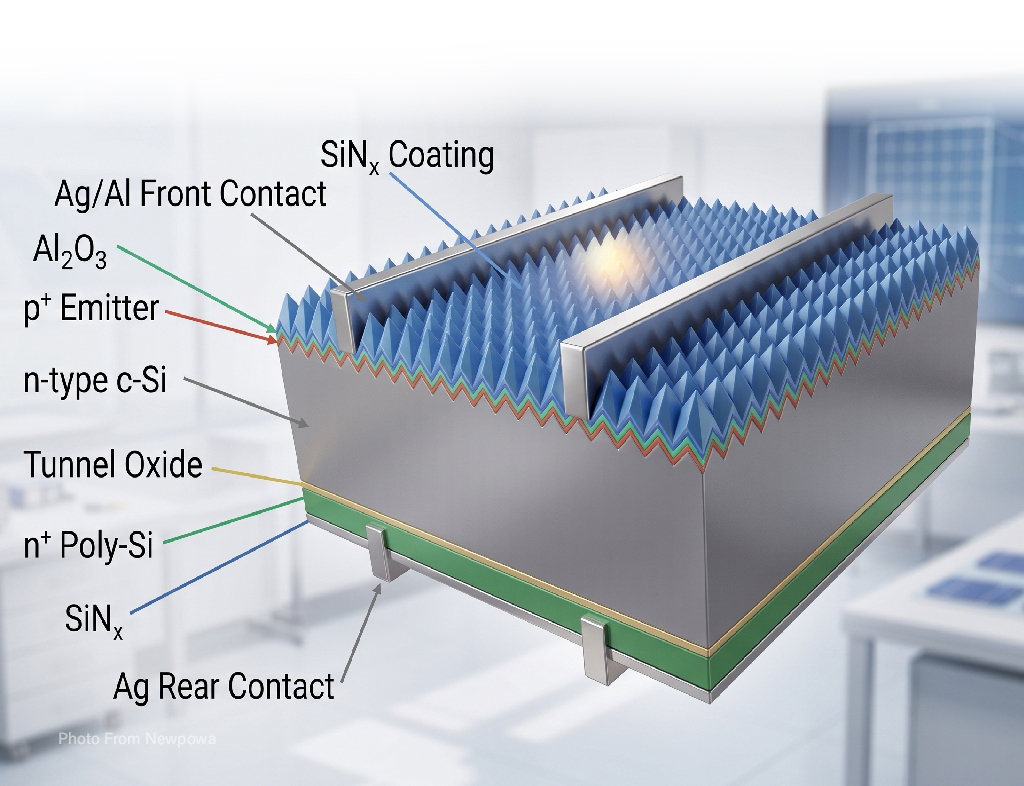
TOPCon solves this recombination problem through advanced material engineering. It is an N-type silicon cell that features an ultra-thin tunnel oxide layer paired with a doped polycrystalline silicon layer on the back.This microscopic tunnel oxide layer acts as a selective filter: it allows the electrical current (electrons) to pass through easily, but blocks the empty spaces (holes) from recombining with them. The result is a massive reduction in energy loss at the cell's contacts, unlocking significantly higher power generation.
Why Commercial Procurement Needs TOPCon
For wholesale buyers, the transition to TOPCon isn't just about chasing the latest tech—it is a direct lever for improving system ROI and lowering the Total Cost of Ownership (TCO) across bulk purchases.
Here is why TOPCon is aggressively replacing PERC in B2B supply chains:
- Zero Light-Induced Degradation (LID)
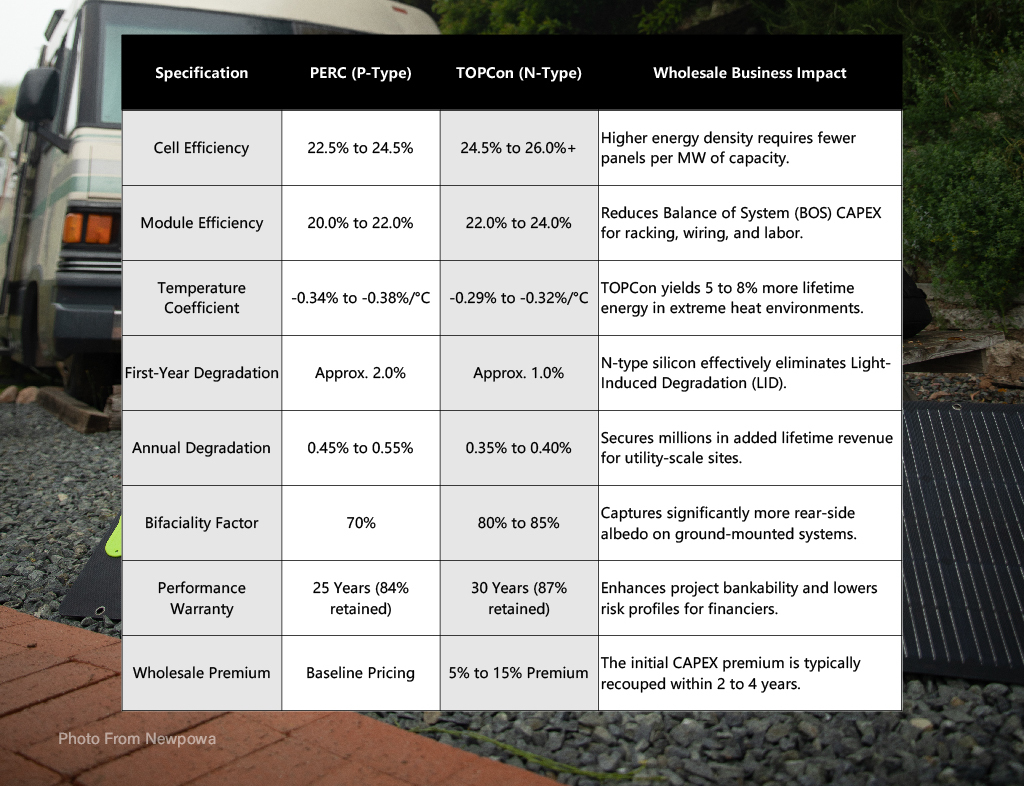
Standard P-type PERC panels suffer from Light-Induced Degradation (LID). When standard panels are first exposed to sunlight, oxygen and boron inside the silicon react, permanently dropping the panel’s efficiency by 1–3% almost immediately. Because TOPCon uses N-type silicon (doped with phosphorus instead of boron), it completely eliminates the boron-oxygen defect. Your commercial fleets experience near-zero LID, preserving their rated wattage out of the gate.
- Superior Power Density
Commercial PERC modules typically max out around 22.5% efficiency. TOPCon cells consistently hit mass-production efficiencies of 24% to 26%. For commercial deployments, this means generating more watts per square meter. You can achieve the same power target using fewer panels, which aggressively cuts down on mounting hardware, racking costs, and installation labor.
- High-Temperature Durability
Solar panels lose efficiency as they get hotter. Standard PERC panels typically have a temperature coefficient of around -0.35% per degree Celsius. TOPCon panels boast a superior coefficient, often around -0.29% to -0.30%. For installations in the Sun Belt or industrial rooftops that bake in the summer heat, TOPCon modules will consistently output more actual kilowatt-hours than identically rated PERC modules.
- Extreme Bifaciality
If your projects involve ground-mounts or highly reflective commercial roofs, TOPCon offers an extreme advantage. While PERC panels can be bifacial (capturing light from the rear), their bifaciality factor caps at about 70%. TOPCon’s cell structure allows for a bifaciality factor of 80% to 85%. When deployed over white gravel or reflective membranes, the backside yield generation provides a massive boost to the system's total output.
The Bottom Line for Wholesale Purchasing
While TOPCon panels currently command a slight premium over mature PERC modules, the unit-cost difference is rapidly shrinking. When factoring in the 30-year lifecycle of a commercial project, the math heavily favors TOPCon.The combination of higher baseline efficiency, lower annual degradation (roughly 0.4% vs PERC's 0.5%), and better thermal performance means TOPCon delivers a substantially lower Levelized Cost of Electricity (LCOE).For B2B procurement managers planning bulk inventory or large-scale project deployments for 2026 and beyond, securing TOPCon modules isn't an upgrade—it is a requirement to stay competitive.
Ready to upgrade your commercial inventory? Connect with our commercial sales team to discuss bulk pricing, availability, and how TOPCon integration can lower your TCO.
TOPCon vs. PERC 25-Year Yield & ROI Simulator
Simulate long-term generation capacity, power degradation rates, and financial returns for off-grid and commercial solar installations.
Technical Specification Comparison
| Feature / Metric | Newpowa TOPCon (N-Type) | Standard PERC (P-Type) |
|---|---|---|
| First-Year Power Degradation | 1.0% | 2.0% |
| Annual Linear Degradation | 0.4% / year | 0.55% / year |
| 25-Year Power Guarantee | 89.4% Retained | 84.8% Retained |
| Bifaciality Factor | Up to 80% | ~70% |